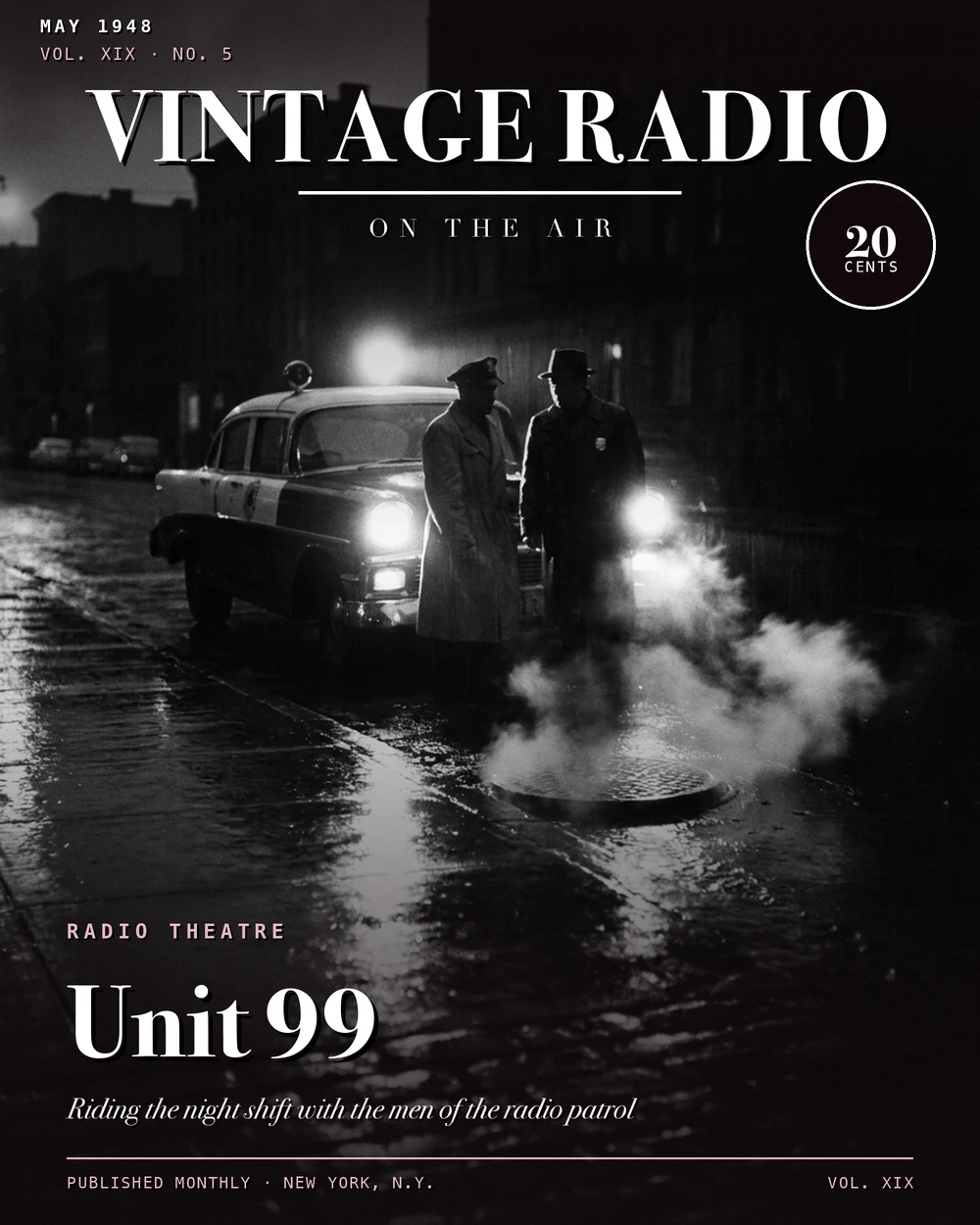
Unit 99
A Police Sergeant, a Tape Recorder, and the Real Thing
What set Unit 99 apart from every other crime-detective program on 1950s radio was simple: none of it was scripted. While shows like Dragnet reconstructed police work in a Hollywood studio, Unit 99 put Sacramento Police Sergeant Dan Meredith in an actual squad car with a portable tape recorder and sent him out on real calls. He brought the recorder to crime scenes, interviewed victims and bystanders on the spot, and narrated what was happening as it happened. The result was something radio hadn't done before in quite this way — a documentary field-recording of working law enforcement, broadcast to audiences across the country and beyond.
The show premiered on August 23, 1957, and ran through June 6, 1958, producing 42 episodes over the course of roughly ten months. Each episode ran about 25 minutes, putting the full run at just over seventeen hours of recorded material. That might not sound like much compared to the long-running scripted dramas of the era, but what those 42 episodes represent is a genuine audio document of what street-level police work looked like in a mid-sized American city in the late 1950s.
Where It Came From
Unit 99 was a local production, originating at KFBK, the ABC radio affiliate in Sacramento, California. KFBK was owned by the McClatchy media company — the same organization behind The Sacramento Bee and a cluster of radio and television properties across California and the Western United States. The show's director was Tony Kester, KFBK's chief announcer and special events director, whose background in live on-location broadcasting made him a natural fit for a format that put microphones in unpredictable situations.
The series carried an additional layer of institutional credibility through its host: James B. Hicks, the Chief of the Sacramento Police Department. Having the actual police chief introduce and frame the program gave it an air of official authority that a purely commercial production couldn't have manufactured. This wasn't a studio actor playing a tough cop — it was the department itself opening its doors to the microphone.
From Sacramento, the show moved outward. Unit 99 aired on ABC and was also picked up for rebroadcast by the Armed Forces Radio and Television Service, which meant servicemen and women stationed around the world could tune in. That distribution gave a locally produced program a reach well beyond its regional origins.
What the Episodes Actually Covered
The episode titles alone tell most of the story. "Disturbance Call," "Riding with Residential Patrol Car," "Shopping Center Burglary," "Man with Dynamite," "Attempted Suicide at Drive-in," "Suicide Attempt at Tower Bridge," "Accident at 12th and E," "Woman Screaming," "Cutting," "Car Being Towed" — these aren't the names of fictional mysteries. They read like a dispatch log, because that's essentially what they were drawn from.
Cases ranged across the full spectrum of what a working police sergeant would encounter: petty theft, larceny, assault, domestic disturbances, accidents, and occasionally more serious crimes including kidnapping and murder. Sergeant Meredith moved through all of it with his recorder running, capturing not just the facts of each call but the texture of how police work actually unfolded — the waiting, the confusion, the conversations with people caught in difficult moments. The show didn't smooth these edges out. Its appeal lay precisely in the unscripted nature of what got recorded.
One forum commenter noted that the audio quality was "surprisingly good for the time period," which speaks to the care taken with the equipment. Capturing usable audio outside a controlled studio environment was not a trivial challenge in 1957, and the fact that the recordings came out clean enough for broadcast suggests that the production team treated the technical side seriously.
The Tradition It Fit Into
Unit 99 wasn't working in a complete vacuum. The closest radio predecessor was Nightwatch, a CBS program from 1954 to 1955 that followed Donn Reed riding along with the Culver City, California police department. Nightwatch established that a ride-along format could work on radio; Unit 99 extended that idea in Sacramento a few years later. The comparison to Dragnet is also reasonable, though instructive in a different way — Dragnet took the materials of real police work and reassembled them into tightly written fiction, while Unit 99 skipped the reassembly entirely.
The longer shadow the show casts, though, is toward television. Commentators have noted that Unit 99 prefigured the format that Fox's COPS would make famous more than three decades later, in 1989. The ride-along reality format — a camera, or in this case a microphone, following a real officer through real calls with no script and no predetermined outcome — is what Unit 99 was doing in 1957. That's a meaningful piece of broadcasting history, even for a show that never became a household name.
What It Left Behind
Unit 99 is not among the most widely remembered programs from its era, and it made no particular claim to being a polished entertainment product in the conventional sense. It was a documentary radio series that ran for less than a year on a regional ABC affiliate, hosted by a police chief and directed by a station announcer. Its ambitions were local and specific.
What gives it staying power as a subject of interest is exactly that specificity. The 42 surviving episodes document a version of law enforcement — the calls, the language, the situations — that existed in Sacramento in 1957 and 1958, captured on tape by a sergeant who was simply doing his job with a recorder running. The show has been noted for its historical significance as one of only a handful of radio programs to use documentary field-recording techniques with actual law enforcement, and its place in the lineage of the reality-format ride-along is well established. That's a real contribution, even from a program that ran under a year and rarely comes up in surveys of the golden age of radio.